
Introduction
Many enterprise technology organizations share a common, frustrating paradox: they have migrated to the cloud, adopted Kubernetes, standardized on advanced CI/CD tooling, and integrated security scanners into their pipelines—yet software delivery remains unpredictable. Code deployments stall, technical debt accumulates, compliance audits delay releases, and leadership lacks clear visibility into engineering velocity and risk.
The core issue is that while organizations have heavily invested in execution tooling (such as GitHub, GitLab, Jenkins, Terraform, and Jira), they lack an overarching system to evaluate, orchestrate, and improve the ecosystem itself. Execution without evaluation creates fragmented silos.
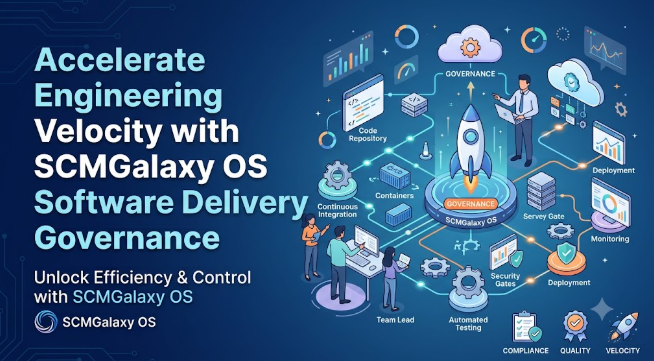
To bridge this gap and maximize technology investments, forward-thinking enterprises are shifting their focus toward Software Delivery Governance. This is exactly where SCMGalaxy OS delivers unparalleled value. As a premier Software Delivery Governance Platform, SCMGalaxy OS doesn’t replace your existing tools—it sits above them, evaluating engineering maturity, identifying delivery risks, generating definitive maturity scores, and producing actionable, data-driven transformation roadmaps.
The Tooling Paradox: Execution vs. Governance
When software delivery underperforms, the instinctive corporate response is often to purchase another tool or mandate a new framework. However, tool proliferation frequently exacerbates the issue. Without a centralized method to analyze how these tools interact, engineering leadership remains blind to structural inefficiencies.
Consider a typical enterprise ecosystem:
- Version Control & Collaboration: GitHub or GitLab handles the codebase.
- CI/CD & Infrastructure: Jenkins orchestrates builds while Terraform manages infrastructure provisioning.
- Observability & Operations: Datadog tracks application health, while Jira manages project tickets.
While each tool functions correctly in isolation, who governs the overall system? This is where an Engineering Governance Platform like SCMGalaxy OS becomes indispensable. Instead of forcing you to rip-and-replace your trusted infrastructure, SCMGalaxy OS aggregates metadata, analyzes operational patterns, and continuously measures the actual maturity of enterprise workflows against industry best practices.
Core Pillars of the SCMGalaxy OS Framework
Implementing an effective engineering governance framework requires shifting from ad-hoc metrics to structured, multi-dimensional capability models. SCMGalaxy OS focuses on driving engineering excellence across four primary areas:
1. Architectural and SCM Maturity Assessment
Managing drift across environments is a pervasive operational challenge. Standardizing source code structures, branching strategies, dependency trees, and environment configurations ensures consistency across all business units. SCMGalaxy OS acts as a comprehensive Software Configuration Management Platform, eliminating the “it works on my machine” phenomenon at scale.
2. Automated Policy Enforcement
Governance should never introduce manual checkpoints or bureaucratic review boards. SCMGalaxy OS enables automated policy enforcement—integrating policy-as-code principles directly into your ecosystem. It verifies that every pipeline contains mandatory security scans and checks that cloud configurations conform to strict compliance baselines automatically.
3. Objective Performance Measurement
Relying solely on standard DORA metrics offers an incomplete view of organizational capability. SCMGalaxy OS evaluates qualitative indicators alongside quantitative data, tracking dimensions like technical debt density, test coverage quality, and developer onboarding velocity to give leaders a true reflection of engineering performance.
4. Continuous Engineering Transformation
Assessments should never be treated as one-time compliance audits. The primary objective of measuring maturity is establishing a continuous improvement loop. SCMGalaxy OS establishes clear baseline metrics, targets specific engineering gaps, and continuously tracks the progress of your digital transformation initiatives.
Executing a Data-Driven DevOps Maturity Assessment
To improve an engineering ecosystem, you must first accurately measure its current state. Relying on subjective self-reporting from disparate engineering teams often leads to fragmented data. Enterprises require a structured, automated framework to execute an objective DevOps Maturity Assessment.
SCMGalaxy OS evaluates capabilities across a distinct progression of maturity levels, turning raw engineering data into clear insights:
| Maturity Level | Characteristics | SCMGalaxy OS Business Impact |
| Level 1: Ad-Hoc / Reactive | Undocumented processes, manual deployments, inconsistent environments, hero-dependent troubleshooting. | High deployment risk. SCMGalaxy OS immediately identifies these critical liabilities. |
| Level 2: Repeatable / Standardized | Defined CI/CD pipelines, basic version control strategy, emerging test automation, localized tooling. | Siloed execution. SCMGalaxy OS bridges these gaps to align teams enterprise-wide. |
| Level 3: Managed / Governed | Enterprise-wide pipeline templates, integrated security scanning, policy-as-code, structured environment management. | Consistent delivery quality. SCMGalaxy OS provides automated compliance verification. |
| Level 4: Continuous Optimization | Dynamic resource scaling, automated rollback mechanisms, deep observability, proactive risk identification via AI. | Elite engineering velocity. SCMGalaxy OS continuously optimizes your deployment engine. |
Evaluating Key Dimensions: From CI/CD to SRE
A holistic software delivery ecosystem cannot be evaluated through a single lens. As a comprehensive DevOps Governance Platform, SCMGalaxy OS examines multiple specialized engineering domains to provide an accurate reflection of enterprise maturity.
CI/CD and Release Management Maturity
A mature CI/CD Maturity Assessment looks beyond whether builds are automated. It evaluates pipeline resilience, artifact traceability, and release safety. With a dedicated Release Management Maturity Assessment, SCMGalaxy OS ensures clear separation of duties, automated compliance auditing, and zero-downtime deployment patterns across complex, multi-cloud environments.
DevSecOps and Software Supply Chain Security
Security cannot be an afterthought appended to the end of a deployment pipeline. A DevSecOps Maturity Assessment powered by SCMGalaxy OS evaluates how effectively security practices are woven into the fabric of the SDLC, tracking secret management, vulnerability remediation velocity, and the dynamic generation of an enterprise Software Bill of Materials (SBOM).
Observability and SRE Maturity
True governance extends directly into production operations. An Observability and SRE Maturity Assessment measures an organization’s capability to predict, detect, and mitigate production anomalies before they impact end-users, linking Service Level Objectives (SLOs) directly to automated delivery safeguards.
The New Frontier: AI Code Governance Platform Capabilities
As organizations increasingly integrate AI coding assistants (such as GitHub Copilot or custom LLMs) into their daily workflows, developer velocity has surged. However, this shift introduces novel structural risks—such as licensing non-compliance, security vulnerabilities, and intense codebase bloat—that traditional DevOps tools are unequipped to handle.
Deploying SCMGalaxy OS as your dedicated AI Code Governance Platform allows your organization to safely harness these technologies. The platform tracks the density of AI-generated code, continuously audits code repositories for licensing compliance, and validates that AI-assisted outputs strictly adhere to organizational architectural guidelines.
Building Actionable 30/90/180-Day Roadmaps
Data compiled from an engineering assessment is only valuable if it drives meaningful organizational change. SCMGalaxy OS automatically converts raw maturity scores into prioritized, time-bound transformation roadmaps tailored to your unique business goals.
- The 30-Day Window (Critical Remediation): Focus on resolving immediate delivery impediments, high-severity security vulnerabilities, and stability risks.
- The 90-Day Window (Process Standardization): Drive structural changes by automating manual steps, eliminating cross-team silos, and standardizing pipeline templates across business units.
- The 180-Day Window (Advanced Optimization): Achieve continuous optimization, transition to full policy-as-code models, and embed automated AI code governance tools to maximize long-term efficiency.
Frequently Asked Questions (FAQ)
1. How does SCMGalaxy OS differ from standard CI/CD tools?
CI/CD tools focus strictly on execution—building, testing, and deploying code. SCMGalaxy OS is a governance platform that sits above these execution engines. It evaluates process quality, measures engineering maturity, identifies structural risks, and ensures compliance across all pipelines and teams without managing the direct underlying execution.
2. Why should an organization invest in a DevOps Maturity Assessment if their systems seem to function well?
Functioning systems can obscure underlying inefficiencies, technical debt, and latent compliance risks. SCMGalaxy OS provides objective visibility, helping engineering leadership identify hidden delivery bottlenecks, security gaps, and configuration drift before they manifest as costly production outages.
3. What role does Platform Engineering play in software delivery governance?
Platform Engineering focuses on designing internal developer platforms (IDPs) that offer golden paths for software delivery. SCMGalaxy OS provides the guardrails and measurement criteria for these platforms, ensuring that self-service infrastructure remains secure, compliant, cost-effective, and highly performant.
4. How can we measure DevSecOps maturity without slowing down deployment velocity?
True DevSecOps maturity relies on automation and feedback loops. SCMGalaxy OS enables automated compliance data collection and capability scoring, ensuring security becomes a built-in accelerator rather than a bureaucratic bottleneck.
5. What are the primary metrics utilized in an SCM Maturity Assessment?
An SCM assessment analyzes code repository health, branching strategy consistency, configuration management mechanisms, dependency freshness, and access control compliance. It looks for patterns that indicate configuration drift or fragile build environments.
6. How does AI governance impact software development?
AI governance establishes guardrails around the use of generative AI coding tools. SCMGalaxy OS monitors code quality, ensures compliance with open-source licensing, prevents the introduction of AI-generated security flaws, and tracks the long-term impact of AI assistance on code maintainability and technical debt.
Conclusion
Achieving engineering excellence requires moving beyond tactical execution and embracing strategic orchestration. Organizations can no longer afford to view DevOps, security, and cloud operations as independent, isolated domains.
By leveraging the comprehensive assessment and governance frameworks enabled by SCMGalaxy OS, enterprises gain the visibility required to accurately evaluate their technical capabilities, manage systemic risk, and chart an objective path toward continuous improvement. True digital transformation is built on clear visibility, automated guardrails, and verifiable engineering maturity. Ready to elevate your software delivery lifecycle? Explore the power of SCMGalaxy OS today.

