
Introduction
Class 12 is an important turning point for every student in India. School education provides structured textbooks and board exams. Entrance tests, however, demand conceptual speed, logical reasoning, and deep subject application.
Navigating the transition after school can feel overwhelming. Many students register for tests without understanding the eligibility rules or marking schemes. Others pick career paths simply because their peers did.
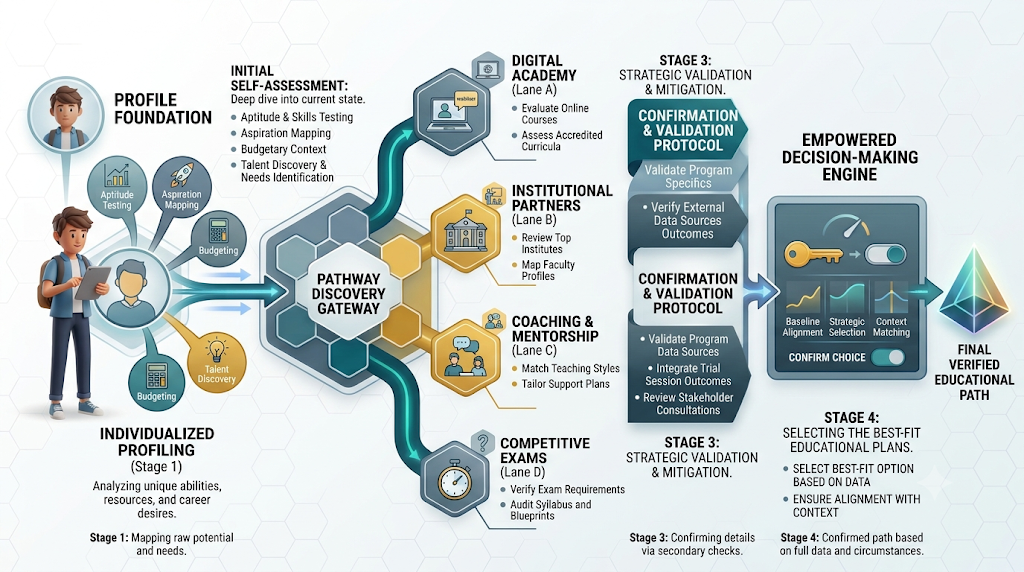
This guide breaks down the major competitive exams after 12th across Science, Commerce, and Arts. It also explains practical study planning, how to assess coaching options, and how to make informed higher education decisions.
Why Early Planning Matters After Class 12
School board exams evaluate descriptive answers, step-by-step solutions, and memorized definitions. In contrast, most competitive exams in India evaluate speed, negative marking discipline, and deep conceptual clarity.
Preparing for entrance exams requires a different mindset:
- Time limits are strict: You often have less than two minutes per question.
- Negative marking exists: Guessing answers without logic lowers your overall score.
- Syllabus breadth is large: Most entrance tests cover topics from both Class 11 and Class 12.
Starting your research early prevents last-minute stress. When you understand the syllabus, application windows, and minimum marks required, you can create a realistic daily routine.
Science Stream: Engineering and Technical Pathways
Students with Physics, Chemistry, and Mathematics (PCM) have access to national and state-level engineering entrance exams.
Class 12 (PCM) ──► JEE Main ──► NITs / IIITs / GFTIs
                     │
                     └──► JEE Advanced ──► IITs
                     │
                     └──► State CETs / Private Entrances ──► State & Private Colleges
1. JEE Main (Joint Entrance Examination Main)
JEE Main is the largest engineering entrance test in India. The National Testing Agency (NTA) conducts this national computer-based test twice a year.
- Eligibility: Candidates must have passed Class 12 with Physics, Mathematics, and one optional subject (such as Chemistry, Biology, or a technical vocational subject).
- Admission Opportunities: Qualifies students for National Institutes of Technology (NITs), Indian Institutes of Information Technology (IIITs), and Centrally Funded Technical Institutes (CFTIs).
- Role as a Screening Test: The top candidates from JEE Main become eligible to appear for JEE Advanced.
2. JEE Advanced
JEE Advanced is conducted by one of the zonal Indian Institutes of Technology (IITs) under the guidance of the Joint Admission Board (JAB).
- Eligibility: Only top rankers from JEE Main who meet category-wise cut-offs can register. Candidates can attempt this exam a maximum of two times in consecutive years.
- Admission Opportunities: It is the exclusive entrance route to undergraduate engineering and science programs at the Indian Institutes of Technology (IITs).
- Format: It features two mandatory papers containing multiple-choice, numerical, and list-match questions designed to test deep problem-solving skills.
3. State-Level Engineering Entrances
Many states hold independent entrance examinations for admissions to government and private engineering institutions within their borders. Examples include MHT CET (Maharashtra), WBJEE (West Bengal), and KCET (Karnataka). These exams often align closely with state board textbooks.
Science Stream: Medical, Dental, and Life Sciences
Students with Physics, Chemistry, and Biology (PCB) pursue medical, dental, veterinary, and allied healthcare fields.
1. NEET-UG (National Eligibility cum Entrance Test)
NEET-UG is the single unified entrance examination for undergraduate medical education across India.
- Eligibility: Candidates must have completed Class 12 with Physics, Chemistry, Biology/Biotechnology, and English. Candidates must also meet the minimum age requirement of 17 years at admission.
- Admission Opportunities: MBBS, BDS, BAMS, BHMS, BUMS, and BSMS programs in all medical colleges across India, including AIIMS and JIPMER.
- Format: A pen-and-paper test comprising 180 questions across Physics, Chemistry, and Biology (Botany and Zoology). Negative marking applies for incorrect responses.
2. Allied Health and Agricultural Entrances
Medical students can also consider alternatives to traditional clinical degrees:
- ICAR AIEEA (via CUET): For admission into agricultural science, horticulture, and forestry degrees.
- State Nursing Entrances: For Bachelor of Science programs in Nursing and Paramedical sciences.
- NEET for Veterinary Science: Admission to Bachelor of Veterinary Science (BVSc & AH) programs through the Veterinary Council of India quota.
Commerce and Management Pathways
Students with a Commerce background have entrance options leading to professional corporate credentials, accounting certifications, and management programs.
Class 12 (Commerce) ──► CA Foundation ──► ICAI Chartered Accountancy
                      ──► CSEET ──► Company Secretary
                      ──► IPMAT ──► Integrated MBA (IIMs)
                      ──► CUET-UG ──► Central Universities (B.Com / BBA / Economics)
1. CA Foundation
The Institute of Chartered Accountants of India (ICAI) conducts the CA Foundation examination three times a year.
- Eligibility: Students can register after passing Class 10 and sit for the exam after appearing for Class 12 board examinations.
- Curriculum: Covers Accounting, Business Laws, Quantitative Aptitude (Mathematics, Logical Reasoning, Statistics), and Business Economics.
- Progression: Clearing Foundation allows entry into the CA Intermediate stage.
2. CSEET (CS Executive Entrance Test)
Conducted by the Institute of Company Secretaries of India (ICSI), CSEET is the qualifying entrance for the Company Secretary course.
- Eligibility: Passed or appearing in Class 12 in any stream (except Fine Arts).
- Test Areas: Business Communication, Legal Aptitude, Logical Reasoning, Economic and Business Environment, and Current Affairs.
3. IPMAT (Integrated Program in Management Aptitude Test)
Several Indian Institutes of Management (such as IIM Indore and IIM Rohtak) offer a five-year integrated management degree (BBA + MBA) directly after Class 12.
- Focus Areas: Quantitative Ability, Verbal Ability, and Data Interpretation.
- Selection: Candidates who clear the written test typically undergo a personal interview before final selection.
Arts, Humanities, and Law Pathways
Arts and Humanities offer varied career routes, including civil administration, corporate law, design, public policy, and media.
1. CLAT (Common Law Admission Test)
The Consortium of National Law Universities organizes CLAT for admission to five-year integrated law programs (BA LLB, BBA LLB, B.Com LLB).
- Eligibility: Minimum 45% marks in Class 12 for General/OBC categories (40% for SC/ST). There is no upper age limit.
- Syllabus: Reading comprehension, Current Affairs including General Knowledge, Legal Reasoning, Logical Reasoning, and Elementary Mathematics.
- Participating Colleges: 24+ National Law Universities across India.
2. AILET (All India Law Entrance Test)
National Law University, Delhi conducts its own separate entrance test, AILET. The test assesses English language proficiency, logical reasoning, and general knowledge.
3. Design and Fine Arts Entrances
Students interested in creative design can take national-level aptitude examinations:
- UCEED: Conducted by IIT Bombay for Bachelor of Design (B.Des) programs.
- NID DAT: For the National Institute of Design.
- NIFT Entrance Exam: For fashion technology and design courses.
Pan-Stream and University Admissions: CUET-UG
The Common University Entrance Test (CUET-UG), organized by the NTA, has unified undergraduate admissions for Central, State, Deemed, and private universities across India.
CUET-UG allows students to select subjects that match their Class 12 studies and target degree requirements:
- Section IA & IB: Language tests evaluating reading comprehension, vocabulary, and literary aptitude.
- Section II: Domain-specific subjects (such as Accountancy, History, Physics, Political Science, or Chemistry) based on the Class 12 syllabus.
- Section III: General Test evaluating general knowledge, numerical ability, and quantitative reasoning.
CUET scores are accepted by institutions like the University of Delhi, Banaras Hindu University, and Jamia Millia Islamia.
Government and Defense Opportunities After 12th
Students who wish to serve in the armed forces or secure public-sector employment directly after school can consider direct recruitment tests.
| Exam Name | Conducting Body | Minimum Eligibility | Key Selection Stages |
| NDA & NA Exam | Union Public Service Commission (UPSC) | Class 12 (PCM for Air Force/Navy; Any stream for Army) | Written test (Maths & General Ability) followed by SSB Interview and Medicals |
| SSC CHSL | Staff Selection Commission | Class 12 pass from a recognized board | Computer-Based Examination (Tier 1 & Tier 2) followed by Skill/Typing test |
| Indian Navy Agniveer | Indian Navy | Class 12 with Maths & Physics | Computer-based examination, physical fitness assessment, medicals |
| Indian Air Force Agniveervayu | Indian Air Force | Class 12 with Maths, Physics, English OR 3-year Diploma | Online test, physical efficiency test, adaptability assessment |
How to Evaluate Competitive Exams Before Registering
Before submitting application fees, students and parents should verify four basic criteria:
- Academic Eligibility and Subject Requirements: Some degrees demand specific high school subjects. For instance, an architecture degree requires Mathematics in Class 12, even if you clear the general aptitude test.
- Marking Structure and Negative Marks: Always calculate the penalty for wrong answers. Tests like JEE and NEET deduct marks for incorrect guesses, whereas some state-level entrance tests do not carry negative marking.
- Attempt Limits and Age Rules: Exams like JEE Advanced restrict the total number of attempts to two consecutive years. In contrast, exams like CLAT do not impose an upper age limit.
- Seat Matrix and Regional Quotas: Look up home-state quotas, central university reservations, and institutional seats early. This helps set realistic score targets.
Building a Realistic Competitive Exam Preparation Plan
Clearing entrance tests requires consistent daily practice rather than last-minute cramming. Here is how students can structure their study routines alongside school boards:
Step 1: Understand the Official Syllabus & Exam Pattern
                        │
Step 2: Build Fundamentals using Standard Textbooks (e.g., NCERT)
                        │
Step 3: Daily Problem Practice & Formula Revision
                        │
Step 4: Weekly Topic Tests & Error Journaling
                        │
Step 5: Full-Length Timed Mocks & Speed Calibration
1. Master Fundamental Textbooks First
NCERT textbooks remain the benchmark for exams like NEET, JEE Main, and CUET. Build clear conceptual understanding from foundational books before moving to advanced problem collections.
2. Practice Active Problem-Solving
Passive reading rarely builds problem-solving speed. Solve objective questions under timed conditions every day. Keep a separate notebook for incorrect answers to understand where your reasoning failed.
3. Take Timed Mock Tests Regularly
Mock tests help you adapt to computer-based testing environments. They show you how to manage your time across different sections, skip difficult questions, and maintain focus for three continuous hours.
Finding the Right Preparation Support: Tutors and Coaching
Every student learns at their own pace. While some students study effectively on their own, others need structured academic guidance to cover complex topics.
Individual Tutors: Online vs. Local
When a student struggles with specific subjects—such as organic chemistry reactions or calculus—a dedicated tutor can provide direct help.
- Find Tutors Online: Online tutoring offers scheduling flexibility and access to teachers across India. This is especially helpful for niche subjects or advanced entrance topics.
- Find Tutors Near Me: Local tutors provide face-to-face accountability and an understanding of regional board syllabi.
When searching for tutors, check their experience with competitive exam patterns, ask about their regular doubt-clearing methods, and request a trial session before committing.
Evaluating Coaching Institutes Objectively
Enrolling in coaching institutes is common among competitive exam candidates. However, big claims in advertisements should always be evaluated carefully.
- Faculty Continuity: Inquire whether primary subject teachers handle batches for the entire academic year.
- Batch Size: Smaller batches allow teachers to answer questions and monitor individual progress.
- Testing Systems: Check if the institute provides regular mock tests with detailed performance reports.
- Location and Commute: Long daily commutes take away valuable self-study and rest time. If you are researching coaching institutes near me, pick one that allows you to maintain a healthy daily schedule.
Comparing the best coaching institutes in India requires evaluating real classroom environments and teaching methods, not just marketing posters.
Connecting Exam Scores to Colleges and Degrees
An entrance exam score is only one part of the admissions process. Once exam results are declared, students must research colleges and compare academic programs.
- Accreditation and Affiliation: Check whether the institution holds recognition from relevant regulatory bodies, such as the UGC, AICTE, BCI, or NMC.
- Curriculum Updates: Look for course syllabi that include modern industry tools, laboratory training, and practical electives.
- Campus Resources: Review functional laboratories, libraries, research facilities, and residential support.
- Fee Structure and Refund Policies: Understand tuition fees, hostel expenses, and university examination fees before paying seat-acceptance charges.
A structured college search in India helps families compare colleges and courses on objective factors rather than relying on unverified claims.
Common Mistakes to Avoid During Preparation
- Ignoring School Board Preparation: Focusing entirely on entrance tests while neglecting board exams can backfire. Many universities and exams require minimum board percentages (often 60% to 75%) to confirm eligibility.
- Hoarding Multiple Study Materials: Studying the same chapter from four different reference books creates confusion. Pick one reliable primary book and supplement it with past-year papers.
- Overlooking Physical and Mental Rest: Irregular sleep and skipped meals hurt memory retention and concentration. Aim for at least seven hours of regular sleep every night.
- Failing to Analyze Mock Tests: Taking a three-hour mock test is only half the job. Spend an equal amount of time reviewing mistakes, unattempted questions, and incorrect calculations.
How GurukulGalaxy Supports Education Discovery
Choosing the right educational path involves multiple decisions: finding a reliable subject mentor, selecting an entrance test, evaluating local coaching centres, and shortlisting prospective colleges.
GurukulGalaxy functions as an education discovery platform designed to simplify this search for students and parents across India:
- Tutor Discovery: Search verified teacher profiles by subject expertise, teaching format, and locality. Whether you prefer to find tutors online or find tutors near me, you can evaluate educators based on teaching experience and direct enquiries.
- Coaching and Institution Discovery: Explore local education options, compare coaching institutes near me, and review learning centres without biased rankings.
- College and Course Research: Conduct informed college search in India and compare colleges and courses using objective criteria like eligibility, duration, and academic specializations.
- Exam Information: Access structured overviews of competitive exams in India, including eligibility guidelines, selection stages, and preparation pathways.
Using an independent discovery platform helps students compare learning options calmly and make choices that fit their academic goals.
FAQ Section
What are the most popular competitive exams after 12th for science students?
The most widely taken exams are JEE Main and JEE Advanced for engineering, and NEET-UG for medical, dental, and allied health sciences. Students can also sit for state CETs, CUET-UG for central university science degrees, and the NDA entrance exam for defense careers.
Can arts students appear for any competitive exams after 12th?
Yes. Arts students can appear for law entrance exams like CLAT and AILET, central university entrance tests via CUET-UG, design entrance exams like NID DAT and UCEED, defense services through the Army wing of the NDA, and government job tests like SSC CHSL.
How is CUET-UG different from traditional university admissions?
CUET-UG replaces variable Class 12 board cut-offs with a standardized, national entrance test. Participating universities evaluate candidates on their CUET subject scores rather than relying solely on differing state and central board percentages.
What is the minimum percentage required in Class 12 to appear for competitive exams?
Eligibility varies by examination. For example, JEE Main generally requires passing marks in Class 12, but admission to NITs and IITs requires 75% aggregate marks (65% for SC/ST) or being in the top 20 percentile of your board. Exams like CLAT require a 45% aggregate. Always verify official eligibility notices for each exam.
How early should a student begin competitive exam preparation?
Most national-level entrance exams cover both Class 11 and Class 12 syllabi. Starting preparation at the beginning of Class 11 provides two full years to master core concepts, complete practice papers, and balance school studies without high stress.
Is self-study sufficient to clear national entrance exams after 12th?
Yes, many students clear competitive exams through disciplined self-study using standard textbooks, past exam papers, and online practice tests. However, students who need structured routines or struggle with complex topics often benefit from guidance through experienced tutors or coaching programs.
How can I find verified tutors near me for exam preparation?
You can use education discovery platforms like GurukulGalaxy to search for tutors by subject, teaching mode, and locality. Review tutor profiles, discuss your learning needs directly, and request a demo class to find a good teaching match.
What factors should I check when choosing coaching institutes near me?
Look at faculty experience, batch size, quality of study materials, regular mock testing facilities, and total travel time. Choose an institute that offers consistent academic support without requiring an exhausting daily commute.
Can I prepare for both board exams and entrance tests at the same time?
Yes. Because most competitive entrance syllabi are based on NCERT and state board curricula, preparing for entrance tests reinforces your board exam fundamentals. Focus on descriptive writing for boards and timed, objective problem-solving for entrance exams.

