
Introduction
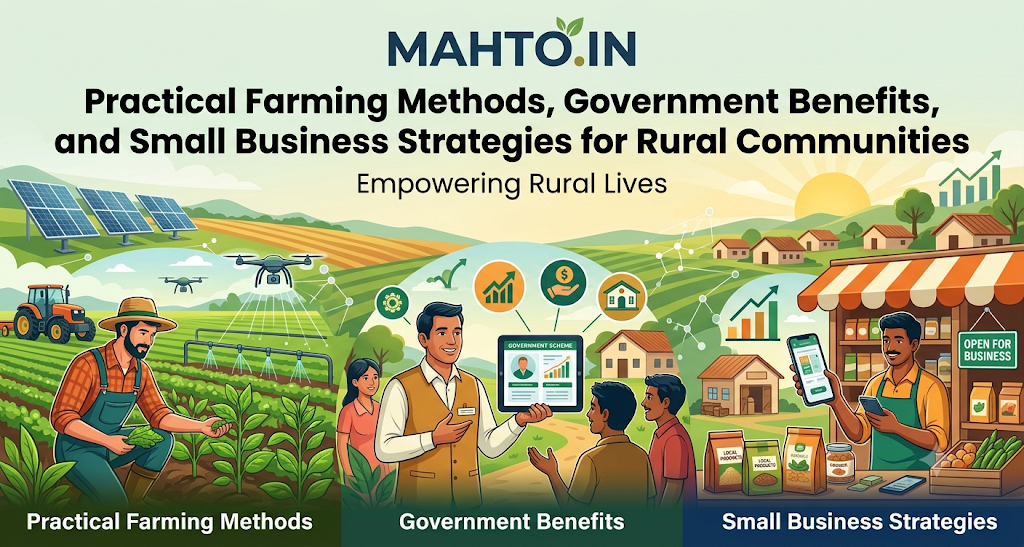
Farming remains the economic foundation of rural India. Agriculture provides food, employment, and income to millions of rural families across every state. Over recent years, agriculture in India has seen significant advancements in field techniques, government support, and market accessibility. Traditional farming practices are evolving as growers adopt efficient methods, sustainable soil care, and modern financial tools to increase crop output and protect their livelihoods.
Understanding reliable methods and government programs is essential for families who want to improve their crop yields or start new agricultural businesses. Finding reliable farming information in Hindi and simple local languages helps rural communities make sound choices regarding seeds, fertilizers, seasonal crop choices, and water management. Access to clear instructions allows rural families to build stable agricultural enterprises.
This guide provides structured information on essential crop production techniques, government support schemes, animal husbandry, agricultural marketing, and small rural business options.
Modern Agricultural Methods and Paddy Cultivation
Crop production requires attention to soil composition, climate conditions, irrigation access, and regional pest pressures. Successful harvests depend on following systematic field practices from land preparation to post-harvest management.
Soil Preparation and Field Planning
Healthy soil forms the foundation of sustainable farming. Testing soil quality using official government resources like the Soil Health Card scheme helps farmers measure essential nutrients, organic matter, and pH balance. Knowing your soil composition prevents excessive use of expensive chemical fertilizers while addressing specific micro-nutrient deficiencies.
Step-by-Step Paddy Production
Paddy is one of the most widely cultivated crops across India, serving as a staple food and major source of income. Farmers who want to learn how to grow paddy should first consider local soil conditions, water availability, suitable varieties, and seasonal weather.
- Seed Selection and Nursery Raising: Select certified high-yielding or native pest-resistant paddy seeds. Soak seeds in water to test viability, then treat them with approved bio-fungicides. Plant seeds in well-prepared nursery beds about 25 to 30 days before field transplanting.
- Field Preparation and Puddling: Plow the main field thoroughly to loosen soil and remove weeds. Flood the field with water and perform puddling to create an impermeable lower soil layer that helps retain standing water during early growth stages.
- Transplanting Seedlings: Gently uproot healthy seedlings from the nursery bed when they develop 4 to 5 leaves. Transplant 2 to 3 seedlings per hill at a uniform depth of 2 to 3 centimeters, keeping equal spacing between rows.
- Water and Weed Management: Maintain a shallow water depth of 2 to 5 centimeters during early growth stages. Drain the field periodically before applying fertilizers and during final crop maturity. Use manual weeding or safe, approved herbicides to control weed growth early.
- Harvesting and Drying: Harvest the paddy crop when grains turn golden-yellow and moisture content drops to approximately 20%. Thresh the harvested crop promptly and dry the grains under sun to bring moisture levels down to 12–14% for safe storage.
+---------------------+-----------------------------------+-----------------------------------+
| Growth Stage        | Water Requirement                 | Key Field Management              |
+---------------------+-----------------------------------+-----------------------------------+
| Nursery Stage       | Light irrigation, moist soil      | Weed control and seedling care    |
| Transplanting       | Shallow water (2-3 cm)            | Uniform plant spacing             |
| Tillering Stage     | Moderate flooding (3-5 cm)        | Balanced fertilizer application   |
| Flowering & Grain   | Consistent moisture maintenance   | Pest and disease monitoring       |
| Pre-Harvest         | Field drainage 10 days prior      | Sun drying and grain moisture test|
+---------------------+-----------------------------------+-----------------------------------+
Transitioning to Sustainable and Organic Farming
Maintaining long-term land productivity requires protecting soil health from excessive chemical runoff, erosion, and nutrient depletion. Organic techniques focus on working with natural biological systems to enhance soil vitality and harvest clean crops.
Foundations of Natural Soil Fertility
Organic agricultural practices focus on feeding the soil rather than feeding the plant directly with synthetic inputs. Enriching fields with farmyard manure, vermicompost, green manures like sunn hemp, and bio-fertilizers increases organic carbon levels. High organic carbon content improves soil water-retention capacity, supports beneficial soil microbes, and makes crops more resilient to dry spells.
Practical Steps for Agricultural Conversion
Growers researching how to start organic farming should begin by converting a small plot of land, preparing on-farm organic inputs, and avoiding synthetic fertilizers or chemical pesticides.
- Establish Buffer Zones: Separate organic plots from conventional fields using hedge rows or physical boundaries to protect crops from spray drift.
- Produce On-Farm Fertilizers: Set up composting pits and vermicompost units using farm waste, crop residues, and cattle dung.
- Implement Crop Rotation: Alternate nitrogen-demanding crops with legumes like cowpea, chickpea, or lentil to fix atmospheric nitrogen into the soil naturally.
- Adopt Biological Pest Management: Use neem-based sprays, sticky traps, and beneficial insects to manage farm pests without resorting to chemical sprays.
- Seek Certification: Register with the Paramparagat Krishi Vikas Yojana (PKVY) or the Participatory Guarantee System for India (PGS-India) to gain official organic certification and earn higher prices in regional markets.
Financial Assistance and Government Agricultural Schemes
The Ministry of Agriculture and Farmers Welfare, alongside various state government agencies, operates several financial welfare programs designed to protect farmers from climate risks and support routine field expenses.
+------------------------------------+------------------------------------+------------------------------------+
| Government Scheme Name             | Primary Purpose                    | Target Beneficiaries               |
+------------------------------------+------------------------------------+------------------------------------+
| PM-Kisan Samman Nidhi              | Direct income support              | All landholding farmer families    |
| Kisan Credit Card (KCC)            | Low-interest operational credit    | Farmers, tenant farmers, livestock |
| PM Fasal Bima Yojana (PMFBY)       | Crop risk insurance                | Farmers growing notified crops     |
| Soil Health Card Scheme            | Soil testing and fertilizer advice | All crop growers across India      |
+------------------------------------+------------------------------------+------------------------------------+
Income Support through PM-Kisan
The Pradhan Mantri Kisan Samman Nidhi (PM-Kisan) scheme provides direct financial support to eligible landholding farmer families across India. Under this central sector scheme, eligible households receive ₹6,000 annually, transferred directly into their bank accounts in three equal installments of ₹2,000 every four months.
Government schemes for farmers can provide different forms of support, depending on eligibility, location, and the rules of each programme. To receive continuous benefits without interruption, farmers must complete mandatory account verification tasks required by the government portal.
Mandatory eKYC and Verification Requirements
To prevent fraudulent claims and ensure financial support reaches genuine landholders, the Central Government requires beneficiary verification. Completing PM Kisan eKYC requires an Aadhaar-linked mobile number for OTP verification, or an in-person biometric scan at a local Common Service Centre (CSC).
- OTP-Based Verification: Beneficiaries with mobile numbers linked to Aadhaar can complete their verification online via the official PM-Kisan web portal or mobile app.
- Biometric CSC Verification: Farmers without an Aadhaar-linked mobile number can visit any authorized local Common Service Centre to complete verification via fingerprint or iris scanning.
- Land Seeding: Local land revenue authorities must verify land ownership records and link them to the beneficiary’s profile on the official portal.
Short-Term Agricultural Credit and Financial Access
Access to flexible credit helps farmers purchase seeds, fertilizers, field equipment, and animal feed on time. Obtaining a Kisan Credit Card provides farmers with affordable institutional credit at low interest rates, helping them avoid high-interest informal loans.
Key features and benefits of short-term credit cards include:
- Revolving credit limits based on crop patterns, land acreage, and maintenance needs.
- Subsidized interest rates with additional interest subvention for prompt repayment.
- Simplified loan application procedures with minimal collateral for credit limits up to official bank thresholds.
- Credit access for crop cultivation, post-harvest expenses, livestock maintenance, and fish farming activities.
Agricultural Marketing and Price Verification
Securing fair market prices for harvested produce is essential for maintaining profitable farm operations. Market prices shift constantly based on crop arrivals, local demand, transport costs, and national supply trends.
Accessing Real-Time Mandi Rates
Knowing daily market prices helps farmers negotiate effectively with local traders and decide when and where to sell their crops. Learning how to check mandi prices through official agricultural portals like AGMARKNET helps farmers track daily minimum, maximum, and modal prices across regional agricultural markets.
Steps to access reliable mandi prices online:
- Visit official government market portals such as AGMARKNET or state agricultural marketing board websites.
- Select your state, target district, and nearby agricultural market (mandi).
- Choose the specific crop variety to view official daily arrivals and recorded transaction prices.
- Compare prices across neighboring mandis to choose the best venue for selling your harvest.
Livestock Management and Animal Husbandry
Animal husbandry provides stable daily income, protects households against crop failures, and yields valuable organic manure for farming fields.
+---------------------+-----------------------------------+-----------------------------------+
| Livestock Sector    | Key Advantages                    | Primary Management Requirements   |
+---------------------+-----------------------------------+-----------------------------------+
| Goat Farming        | Low capital, high reproduction    | Dry shelter, balanced green fodder|
| Dairy Management    | Daily cash flow from milk sales   | Clean shed, vaccination schedule  |
| Backyard Poultry    | Low investment, egg and meat returns| Secure enclosure, clean water access|
+---------------------+-----------------------------------+-----------------------------------+
Principles of Sustainable Livestock Production
Managing farm animals effectively requires clean housing, balanced nutrition, regular vaccinations, and disease prevention strategies. Reviewing verified livestock farming information helps animal owners improve milk yields, support weight gain, and reduce veterinary costs across their herds.
- Housing and Hygiene: Build well-ventilated animal sheds with non-slip concrete floors, sloped drainage channels, and adequate shade to protect stock from extreme summer heat and winter cold.
- Balanced Animal Nutrition: Feed animals a balanced blend of green fodder, dry straw, and mineral-enriched concentrate feeds to meet their operational nutritional requirements.
- Vaccination and Healthcare: Follow regular local veterinary vaccination schedules for major diseases such as Foot-and-Mouth Disease (FMD), Hemorrhagic Septicemia (HS), and Black Quarter (BQ).
Commercial Goat Production Guidelines
Goat farming is an accessible livestock option for smallholders and landless agricultural workers because goats require relatively low capital, adapt easily to different environments, and face steady market demand for meat. People researching how to start goat farming should assess available space, feed costs, veterinary access, and local demand before investing.
- Breed Selection: Choose proven native or regionally adapted breeds like Sirohi, Jamunapari, Barbari, or Black Bengal based on local climate conditions and production goals.
- Shed Construction: Build elevated wooden or concrete slatted housing to ensure proper ventilation, stay dry, and make manure collection easy.
- Feed Planning: Combine stall feeding with controlled grazing, supplying fresh green fodder (such as leguminous grasses) along with energy-rich grain concentrates.
- Health Management: Deworm goats regularly every three months and vaccinate them against Peste des Petits Ruminants (PPR) and enterotoxemia under veterinary supervision.
Diversifying Income with Rural Entrepreneurship
Relying solely on seasonal farming can create income fluctuations due to erratic weather, pest outbreaks, or market drops. Adding non-farming or value-adding business ventures provides stable cash flow throughout the year.
High-Potential Rural Business Concepts
Exploring practical village business ideas allows rural youth and agricultural households to establish steady sources of secondary income right within their local communities.
+------------------------------------+------------------------------------+------------------------------------+
| Business Model                     | Initial Capital Requirement        | Operational Focus                  |
+------------------------------------+------------------------------------+------------------------------------+
| Vermicompost Unit                  | Low to Moderate                    | Organic waste processing           |
| Flour & Oil Milling                | Moderate to High                   | Grain processing & packaging       |
| Goat & Poultry Breeding            | Moderate                           | Breeding stock & meat sales        |
| Custom Hire Equipment Centre       | High (Bank loans available)        | Farm machinery rental services     |
+------------------------------------+------------------------------------+------------------------------------+
- Custom Hiring Centres for Farm Equipment: Purchase tractors, rotavators, harvesters, or spray equipment to rent out to neighboring smallholders during busy land preparation and harvest seasons.
- Value-Addition and Agro-Processing: Establish small flour mills, oil expellers, or pulse processing units to transform raw farm crops into packaged products for local markets.
- Commercial Vermicomposting Facilities: Convert cattle dung, dry leaves, and organic crop residue into high-quality vermicompost to sell to local organic farmers and home gardeners.
- Rural Transport and Cold Storage Services: Operate small refrigerated or covered transport vehicles to carry fresh vegetables, fruits, and dairy goods reliably from local farms to urban distribution centers.
Accessing Reliable Knowledge for Rural Growth
Access to clear, actionable knowledge helps rural families turn farming efforts into sustainable businesses. Online educational portals like MAHTO.IN offer simple guides on government benefits, local mandi prices, modern crop methods, livestock housing, and rural business planning.
Having reliable information written in straightforward language helps farmers make smart choices about seed selection, land investment, livestock health, and government financial assistance. By using simple digital tools and following good farming practices, rural households can protect their livelihoods and build long-term financial security.
Frequently Asked Questions
How can smallholder farmers verify their eligibility for central government agricultural schemes?
Farmers can verify eligibility by visiting official government portals like PM-Kisan or contacting their local Agriculture Development Officer (ADO). Landholding records, Aadhaar details, and an active bank account are standard requirements for direct benefit transfers.
What is the simplest procedure for completing biometric eKYC for farmer welfare benefits?
Farmers can complete OTP-based verification on the official scheme portal using an Aadhaar-linked mobile number. Those without linked mobile numbers can visit a local Common Service Centre (CSC) to perform biometric fingerprint or iris verification.
How does a Kisan Credit Card help reduce farming production costs?
It provides flexible short-term credit at low, subsidized interest rates. This credit allows farmers to buy quality seeds, fertilizers, and equipment on time without relying on expensive informal loans.
Where can rural crop growers check daily mandi prices for accurate market trends?
Farmers can view updated market arrivals and minimum, maximum, and modal prices on official government platforms like AGMARKNET or state agricultural marketing board websites before selling produce.
What essential inputs are required to start organic farming on a small scale?
Starting organic farming requires quality non-treated seeds, on-farm organic compost, bio-fertilizers like Azotobacter or Rhizobium, neem-based natural pest sprays, and clean buffer zones around fields.
Which livestock options offer steady income opportunities for landless rural households?
Goat farming, backyard poultry, and small-scale dairy units offer flexible income. Goats and poultry require minimal land, have manageable feed costs, and face steady market demand.
What documents are required to apply for agricultural credit cards through public banks?
Standard documents include a completed application form, proof of identity (Aadhaar/Voter ID), address proof, land ownership records or crop cultivation certificates, and passport-size photographs.
How do government weather advisory services protect crops from sudden climate risks?
Official weather services issue localized short- and medium-range weather advisories. These updates help farmers time sowing, fertilizer applications, chemical treatments, and harvests safely around unexpected weather changes.
What steps are needed to build a low-cost, effective shelter for commercial goat farming?
A cost-effective goat shed requires elevated bamboo or wooden slatted flooring, proper roof ventilation, wide overhangs for rain protection, clean feeding troughs, and secure dry bedding areas.
Conclusion
Modern farming requires combining proven field methods, official government financial support, natural resource management, and direct market visibility. By making good use of agricultural tools like the Kisan Credit Card, maintaining soil health through organic practices, tracking market prices on official platforms, and exploring options in livestock and rural enterprise, Indian farming families can increase crop yields and secure reliable multi-stream incomes. Staying informed through accessible rural resources ensures farm families make smart decisions that protect their financial security and land productivity for years to come.

