
Introduction
As enterprise software systems grow in scale, software development teams frequently encounter cognitive overload. Developers must manage containerization configs, write continuous integration pipelines, provision cloud infrastructure, configure service meshes, and handle complex observability matrices. Instead of focusing on business logic and shipping application features, engineering teams spend significant hours debugging configuration drift, cloud permissions, and infrastructure bottlenecks.
This operational complexity bogs down velocity and degrades software delivery performance. To mitigate this friction, modern enterprises are shifting from fragmented operations to structured platform engineering practices. By building internal developer products, organizations can provide structured workflows that streamline shipping code while maintaining governance and security standardizations.
What is Platform Engineering?
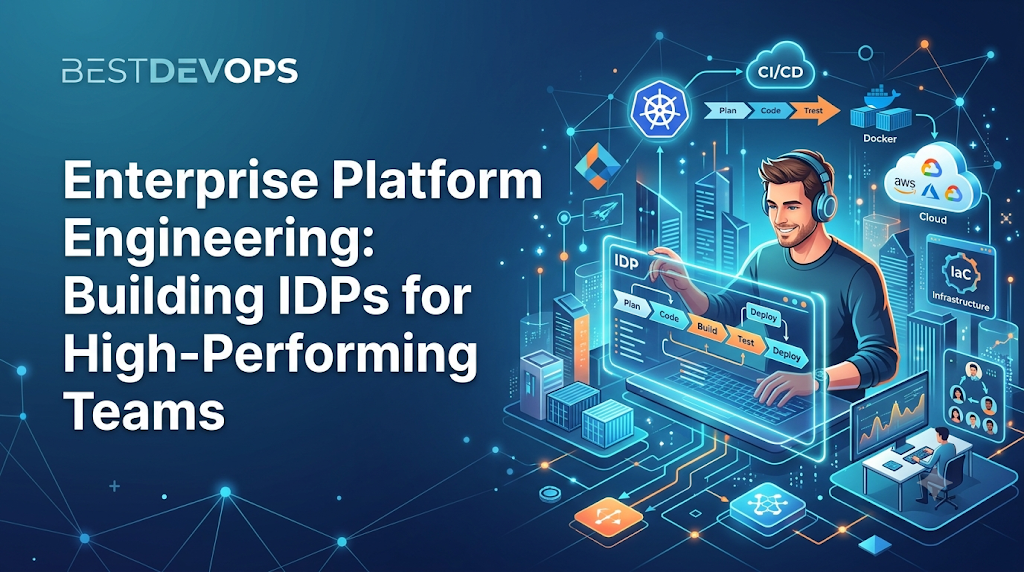
Platform Engineering is the discipline of designing, building, and maintaining Internal Developer Platforms (IDPs) to deliver automated infrastructure operations and self-service capabilities. An IDP is a curated layer of tools, services, and workflows engineered to optimize the developer experience and accelerate product delivery.
+-------------------------------------------------------------+
|                 Software Engineering Teams                  |
+-------------------------------------------------------------+
                              |
                              v  (Self-Service API / UI)
+-------------------------------------------------------------+
|             Internal Developer Platform (IDP)               |
|  [Golden Paths]  [Governance]  [Automation]  [Observability]|
+-------------------------------------------------------------+
                              |
                              v  (Declarative Provisioning)
+-------------------------------------------------------------+
|        Cloud Infrastructure, Kubernetes, CI/CD Tools        |
+-------------------------------------------------------------+
Platform engineers treat the platform as a product, building custom pathways for application developers. This methodology does not replace DevOps; rather, it scales DevOps practices across large teams by baking security compliance, cost monitoring, and architectural standards directly into automated developer workflows.
Why It Matters: Navigating Modern Infrastructure Complexity
The proliferation of microservices, multi-cloud infrastructure, and complex container orchestration systems like Kubernetes has significantly expanded the surface area of modern software delivery. Without a dedicated platform strategy, engineers must repeatedly build delivery pipelines, manage custom Terraform modules, and navigate IAM policies for every new microservice.
By establishing an internal developer ecosystem, organizations reduce this operational friction. Developers gain access to pre-approved blueprints—often called “Golden Paths”—which handle the deployment life cycle automatically. This structured approach allows teams to improve engineering productivity and accelerate time-to-market without compromising compliance or stability.
About BestDevOps
BestDevOps functions as an educational reference and engineering intelligence resource designed for systems architects, cloud practitioners, site reliability engineers, and software delivery leads. The platform provides structured technical roadmaps, hands-on tool comparisons, deployment tutorials, and certification preparation material covering core enterprise domains like infrastructure as code, container orchestration, and continuous integration pipelines. It also features integrated data-driven analytical insights designed to help teams measure software delivery performance, identify workflow blockages, and systematically evaluate key DORA indicators.
Whether you are an enterprise technical manager seeking to standardize multi-cloud infrastructure, or a software engineer looking to advance your technical delivery skills, the platform provides actionable guides tailored to modern operations. By focusing on practical application architectural patterns and systematic automation frameworks, the platform assists engineering teams in mitigating system friction, strengthening delivery consistency, and managing the underlying complexities of cloud-native development. Professionals seeking to design scalable developer products can leverage these resources to establish a strong structural foundation for an enterprise Platform Engineering strategy.
Common Enterprise Infrastructure Challenges
- High Cognitive Overload: Product developers spend excessive time understanding low-level infrastructure tooling, continuous integration specifications, and deployment variations instead of writing features.
- Configuration Drift and Fragmented Pipelines: When teams independently construct their delivery workflows using varying iterations of Jenkins, GitHub Actions, or GitLab CI, maintaining centralized security and compliance policies becomes nearly impossible.
- Ticket-Driven Operations: Developers frequently rely on manual ticketing queues for provisioning databases, domain assignments, or cloud buckets, introducing delivery delays.
- Unoptimized Cloud Spend: A lack of centralized visibility across multi-tenant clusters results in orphaned computing nodes, over-provisioned staging environments, and poor financial management.
Key Concepts of Platform Engineering
Internal Developer Platforms (IDP)
An IDP acts as the primary interface for software engineers. It unifies infrastructure management, deployment instrumentation, and application configuration management into a single control plane.
The Product Mindset
Platform engineering teams operate like software vendors, treating external development groups as customers. They gather user feedback, establish roadmap priorities, and iterate on platform features to ensure high platform adoption.
Golden Paths
A Golden Path is a pre-defined, supported methodology for building and deploying software within an enterprise. Developers using a Golden Path can spin up a microservice complete with CI/CD configurations, monitoring dashboards, and security scanning out of the box, while retaining the freedom to opt out if unique customizations are required.
Architectural Workflow of an Internal Developer Platform
A modern IDP functions by orchestrating application requirements and translating them into physical infrastructure configurations.
[ Developer ] ---> Creates a Service Definition (Catalog UI/CLI)
                          |
                          v
[ Platform Control Plane (e.g., Backstage) ] ---> Registers Component & Metadata
                          |
                          v
[ GitOps Orchestrator (Argo CD / Flux) ] ---> Reconciles State via Git Repository
                          |
                          v
[ Infrastructure Engine (Terraform / Crossplane) ] ---> Provisions Cloud & Kubernetes Resources
                          |
                          v
[ Observability Stack (OpenTelemetry) ] ---> Emits Metrics back to Platform Dashboard
- Initiation: A software developer requests a new service through a developer portal like Backstage or an API definition file.
- Configuration Generation: The platform generates template structures including Backstage catalog metadata, Helm charts, and Dockerfiles.
- Infrastructure Provisioning: Tools like Terraform, OpenTofu, or Crossplane handle the underlying cloud provisioning declaratively.
- Application Deployment: Continuous deployment mechanisms like Argo CD or GitLab CI apply manifests across cloud target zones.
- Telemetry & Metrics: Continuous monitoring via OpenTelemetry, Prometheus, and tools tracking software delivery performance captures behavior and aggregates it back to a unified platform dashboard.
Real-World Enterprise Use Cases
Automated Microservice Onboarding
An e-commerce firm looking to launch a new checkout microservice uses an IDP to instantiate the service. Rather than waiting days for manually provisioned environments, the developer selects a template from an internal catalog. Within minutes, a GitHub repository is initialized with default CI/CD configurations, code analysis checks, and an automated deployment into a non-production Kubernetes cluster.
Centralized Security and Compliance Guardrails
A financial services enterprise implements platform engineering to fulfill compliance frameworks. Security controls, runtime scanning, and vulnerability checks are baked directly into the base platform layers. Vulnerability scans run automatically inside every continuous integration pipeline without manual configuration from product engineers.
Technical and Business Benefits
- Increased Velocity: Standardized workflows help teams deploy code more frequently, reducing change lead times.
- Enhanced Developer Autonomy: Self-service provisioning elements eliminate operational tickets, allowing development teams to operate independently.
- Enforced Governance: Security scans, access configurations, and organizational policies are systematically built into templates, minimizing architectural non-compliance.
- Reduced Cloud Waste: Centralized infrastructure control allows organizations to monitor resource utilization, manage configurations, and prune unneeded development environments automatically.
Best Practices for Platform Teams
Treat the Platform as a Product
Do not force adoption. Collect regular feedback from development teams, run internal user surveys, and design features that solve real friction points for software engineers.
Implement Comprehensive Observability
Integrate centralized tracing, logging, and metrics gathering using open standards like OpenTelemetry. Providing out-of-the-box monitoring dashboards saves product teams from configuring alerting metrics independently.
Track Engineering Metrics Systematically
To understand the platform’s impact, track core engineering metrics like deployment frequency, lead time for changes, change failure rates, and mean time to recovery (MTTR). Using specialized platforms like DevOpsIQ allows teams to query software delivery performance data, analyze operational signals, and identify delivery bottlenecks accurately.
Common Mistakes to Avoid
- Mandating Hard Adoption Rules: Forcing developers onto an unstable, poorly designed platform damages developer trust. Instead, focus on building a platform that developers actively choose to use.
- Reinventing Existing Tooling: Avoid building a proprietary orchestration layer or container manager from scratch. Instead, leverage proven open-source solutions like Kubernetes, Argo CD, Helm, and Backstage, and glue them together logically.
- Neglecting Documentation: Even the most sophisticated internal developer platform will struggle without clear guides, a defined learning path, and comprehensive documentation.
Implementation Strategy and Roadmap
Transitioning to platform engineering requires a phased approach that coordinates culture, tooling, and processes:
Phase 1: Discovery & Assessment (Identify bottlenecks, interview devs, analyze workflows)
                         |
                         v
Phase 2: Establish the Foundation (Standardize CI/CD, IaC, and Kubernetes patterns)
                         |
                         v
Phase 3: Design the Minimal Viable Product (Build initial templates & self-service UI)
                         |
                         v
Phase 4: Scale and Iterate (Integrate telemetry, extend catalog, track engineering KPIs)
- Assess and Discover: Audit your current software delivery processes. Conduct user interviews with your software development teams to map your major deployment bottlenecks.
- Define Golden Paths: Standardize a small set of workflows. Build baseline infrastructure modules using Infrastructure as Code (IaC) tools like Terraform or Ansible, and configure repeatable container patterns with Docker.
- Build a Minimum Viable Platform: Create a unified service catalog or portal interface using tools like Backstage to wrap your underlying automations.
- Integrate Analytics: Connect telemetry hooks and monitoring dashboards to evaluate developer productivity improvements over time.
Platform Engineering vs. Traditional Operations
| Operating Dimension | Traditional Operations | Traditional DevOps Team | Platform Engineering (IDP) Approach |
| Interface Style | Ticket queues, manual requests, long wait times. | Co-managed repositories, custom configurations per project. | Self-service portal interfaces, automated APIs, CLI tooling. |
| Infrastructure Deployment | Manual provisions or siloed scripts. | Ad-hoc script configurations across individual product teams. | Declarative frameworks leveraging GitOps paradigms. |
| Governance and Compliance | Manual code reviews and security validation checks. | Variable security configurations per codebase pipeline. | Guardrails built directly into the platform fabric. |
| Performance Measurement | Service uptime metrics and hardware resource tallies. | Individual team deployment frequencies. | Comprehensive metrics and DORA insight platforms. |
Career Guidance: Transitioning to Platform Engineering
The growth of platform engineering has created strong demand for professionals who understand infrastructure optimization, automation, and user experience design.
Required Skill Sets
- Infrastructure Automation: Strong proficiency with cloud providers, container orchestration via Kubernetes, and Infrastructure as Code using tools like Terraform.
- Software Engineering: Proficiency in languages like Go, Python, or TypeScript to build internal APIs, operators, and dashboard integrations.
- Delivery Instrumentation: Experience managing GitOps deployment workflows using Helm, Argo CD, or Jenkins.
Recommended Learning Pathways
Engineers looking to advance into this space should follow structured training paths:
- Foundational Knowledge: Review a comprehensive DevOps Roadmap to master the underlying fundamentals of containerization, system architecture, and automation.
- Core Tutorials: Complete targeted DevOps Tutorial for Beginners guides to learn the basics of Docker, CI/CD pipelines, and cloud systems.
- Certifications: Earning top certifications—such as Certified Kubernetes Administrator (CKA), HashiCorp Certified: Terraform Associate, or AWS Certified DevOps Engineer—can help validate your technical expertise. For more options, explore comprehensive guides on the Best DevOps Certifications available today.
- Structured Training: Enrolling in a comprehensive Best DevOps Course can help you build the hands-on project experience needed to design internal platforms.
Interview and Career Preparation
Preparing for platform engineering roles requires a solid grasp of systems design, infrastructure scaling, and API development. Aspiring engineers can refine their technical presentation skills by studying targeted DevOps Interview Questions, which often cover architecture, container security, and configuration management.
Compensation trends reflect the high value enterprises place on these skill sets. For detailed market evaluations across regions, check out comprehensive guides on DevOps Engineer Salary metrics to help plan your career progression.
Frequently Asked Questions
Q1. Does platform engineering replace DevOps?
No, it does not replace DevOps. It operationalizes and scales DevOps practices within large organizations. Platform engineering provides the infrastructure, tools, and automated workflows that allow product teams to implement true DevOps principles independently.
Q2. What is the difference between an IDP and a developer portal?
An Internal Developer Portal is the user-facing interface (such as a Backstage UI or service catalog) where developers discover tools, documentation, and APIs. An Internal Developer Platform (IDP) includes the entire underlying backend infrastructure, automation engines, CI/CD tools, and cloud resources that execute the portal’s commands.
Q3. How do we measure the success of a platform engineering team?
Platform success is measured through platform adoption rates, developer satisfaction metrics, and core software delivery KPIs. Tracking these metrics through dedicated telemetry configurations allows teams to evaluate changes in deployment frequency, change lead times, and overall platform performance.
Q4. What are some essential tools for building an IDP?
Common components include portal frameworks like Backstage, infrastructure provisioning tools like Terraform and Crossplane, container orchestrators like Kubernetes, GitOps engines like Argo CD, and telemetry collectors like OpenTelemetry.
Q5. What are “Golden Paths”?
Golden Paths are pre-built, fully supported deployment templates and configurations provided by the platform team. They allow product developers to securely build, deploy, and monitor an application using best-practice patterns without needing to configure complex infrastructure components from scratch.
Q6. Can small startups benefit from platform engineering?
While small startups with few developers may not need a dedicated platform team, adopting a platform mindset early on—such as standardizing your Infrastructure as Code modules and continuous integration patterns—helps prevent messy configuration drift as the organization grows.
Q7. How does DevSecOps integrate into platform engineering?
Platform engineering naturally supports DevSecOps by embedding security compliance directly into platform templates. Security scanning, policy compliance checks, and IAM permissions are managed automatically within the Golden Paths, reducing security overhead for development teams.
Q8. What role do DORA metrics play in platform engineering?
DORA metrics provide the objective baseline data needed to evaluate platform performance. By monitoring metrics like deployment frequency and change failure rates before and after platform updates, engineering organizations can clearly measure the business value of their platform initiatives.
Conclusion
Implementing a reliable infrastructure layer offers a scalable framework for managing the infrastructure complexity of modern cloud-native environments. By treating infrastructure as a product and providing development teams with self-service capabilities and Golden Paths, organizations can reduce cognitive overload and ensure consistent architectural standards.
However, building a successful Internal Developer Platform is not just about assembling open-source tools. True engineering excellence depends on fostering a collaborative engineering culture, continuous feedback loops, robust automation, and a commitment to data-driven improvement. By tracking your delivery performance metrics through comprehensive platforms like DevOpsIQ, your organization can gather the insights needed to eliminate delivery friction, support engineering talent, and build a highly productive software delivery lifecycle.

