
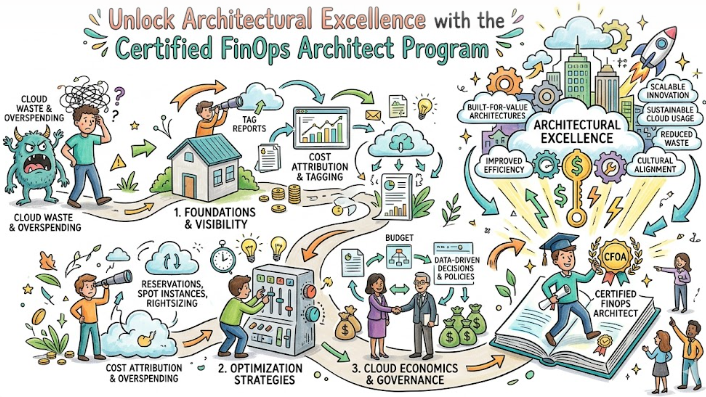
Introduction
Managing cloud expenses has evolved from a simple accounting task into a core engineering discipline. The Certified FinOps Architect designation represents the highest tier of cloud financial management capability for technical leaders. This guide is written specifically for software engineers, platform architects, and engineering managers who need to move past basic cost optimization and build sustainable, automated cloud financial ecosystems. By exploring this roadmap, professionals can make informed career decisions, align engineering output with business value, and master the architectural frameworks required by enterprises globally. You can find comprehensive training resources and official learning pathways directly through Finopsschool.
What is the Certified FinOps Architect?
The Certified FinOps Architect is a professional validation that proves an engineer’s ability to design, implement, and scale cloud financial management practices across complex enterprise environments. Unlike introductory courses that focus merely on tagging resources or reading cloud bills, this architecture-focused program emphasizes production-grade strategies. It covers unit economics, automated cloud governance, architectural trade-offs, and shared accountability models. It exists because modern cloud infrastructure requires technical leaders who understand how architectural decisions directly impact corporate margins and operational velocity.
Who Should Pursue Certified FinOps Architect?
This certification is designed for experienced technical professionals who influence infrastructure spend and architectural design. Cloud architects, DevOps leads, Site Reliability Engineers (SREs), and platform engineers will find immense value in mapping financial efficiency to system performance. It is equally critical for engineering managers and technical directors who must justify cloud budgets to executive leadership while maintaining engineering speed. The curriculum carries strong global relevance, addressing massive cloud waste issues faced by enterprises in North America, Europe, and rapidly scaling digital ecosystems across India.
Why Certified FinOps Architect is Valuable and Beyond
As organizations mature in their cloud journeys, arbitrary cost-cutting is replaced by strategic cloud financial engineering. The demand for architects who can bake financial awareness directly into continuous delivery pipelines is growing rapidly. This certification ensures longevity in a professional career because it focuses on architectural principles and governance frameworks rather than temporary cloud provider discount tools. Investing time in this certification provides a strong return on career progression, shifting a technical professional from an operational cost center to a strategic business enabler.
Certified FinOps Architect Certification Overview
The certification program is structured to evaluate deep technical capability alongside strategic business alignment. Delivered via Certified FinOps Architect and hosted on the Finopsschool platform, the program bypasses superficial multiple-choice testing in favor of scenario-based evaluations. It challenges candidates to solve architectural inefficiencies, design governance policies, and establish organizational KPIs. The structure ensures that a credential holder possesses the practical authority to lead multi-million dollar cloud optimization initiatives within any enterprise environment.
Certified FinOps Architect Certification Tracks & Levels
The learning path is divided into foundational, professional, and advanced architect levels to support structured career progression. The foundational level introduces core cloud financial concepts, terminology, and basic visibility metrics for junior engineering roles. The professional level integrates these financial metrics into active DevOps pipelines, configuration management, and automated scaling policies. The advanced architect level focuses on overarching governance, enterprise-wide unit economics, multi-cloud financial strategy, and organizational transformation management.
Complete Certified FinOps Architect Certification Table
| Track | Level | Who it’s for | Prerequisites | Skills Covered | Recommended Order |
| Cloud Finance | Foundational | Systems Administrators, Cloud Specialists | Basic Cloud Awareness | Cost Allocation, FinOps Lifecycle, Tagging | 1 |
| Engineering | Professional | DevOps Engineers, SREs, Platform Teams | 2+ Years Cloud Infrastructure | Automated Rightsizing, Pipeline Integration | 2 |
| Architecture | Advanced | Principal Architects, Technical Directors | Professional Level Experience | Unit Economics, Enterprise Governance | 3 |
Detailed Guide for Each Certified FinOps Architect Certification
Certified FinOps Architect – Foundational Level
What it is
This level validates a professional’s understanding of basic cloud financial frameworks, terminology, and visibility mechanisms. It ensures the candidate can interpret cloud bills and map expenditures to business units.
Who should take it
Junior cloud engineers, system administrators, and financial analysts who need a clear introduction to engineering-driven cost management.
Skills you’ll gain
- Understanding cloud billing models and anomaly detection.
- Implementing consistent tagging and resource allocation schemas.
- Navigating native cloud provider cost management dashboards.
Real-world projects you should be able to do
- Design a multi-cloud tagging compliance reporting dashboard.
- Identify and clean up unutilized cloud resources across staging environments.
Preparation plan
- 7 Days: Review official documentation, core terminology definitions, and the three primary FinOps phases.
- 30 Days: Work through practical exercises on cost allocation dashboards and study real-world enterprise case studies.
- 60 Days: Not typically required for this foundational tier; consistent study over a few weeks is sufficient.
Common mistakes
- Focusing purely on theoretical finance terms without looking at actual cloud bills.
- Neglecting the cultural aspects of shared accountability across teams.
Best next certification after this
- Same-track option: Certified FinOps Architect – Professional Level.
- Cross-track option: Cloud Platform Professional Certification.
- Leadership option: Certified Cloud Financial Manager.
Certified FinOps Architect – Professional Level
What it is
This certification validates an engineer’s ability to build automated optimization workflows and integrate financial metrics directly into infrastructure management.
Who should take it
DevOps specialists, SREs, and cloud engineers responsible for provisioning, monitoring, and scaling production infrastructure daily.
Skills you’ll gain
- Implementing automated rightsizing policies for containerized workloads.
- Designing commitment-based discount strategies across major cloud providers.
- Integrating financial guardrails directly into CI/CD deployment pipelines.
Real-world projects you should be able to do
- Build an automated lambda-based system to terminate non-compliant infrastructure.
- Optimize Kubernetes cluster resource utilization using automated vertical pod autoscaling.
Preparation plan
- 7 Days: Focus heavily on container cost allocation strategies and advanced reservation models.
- 30 Days: Set up sandbox cloud environments to build automated script alerts for spending anomalies.
- 60 Days: Review complex multi-tenant architecture challenges and complete full mock examination assessments.
Common mistakes
- Relying too much on manual intervention rather than designing automated remediation scripts.
- Failing to calculate the operational engineering effort against the actual cost savings.
Best next certification after this
- Same-track option: Certified FinOps Architect – Advanced Level.
- Cross-track option: Advanced Site Reliability Engineering Certification.
- Leadership option: Engineering Operations Director Path.
Certified FinOps Architect – Advanced Level
What it is
The highest tier credential validating a professional’s ability to architect global cloud financial governance frameworks and establish corporate unit economics.
Who should take it
Principal architects, enterprise cloud leaders, and technical directors managing large-scale, multi-million dollar cloud portfolios.
Skills you’ll gain
- Designing corporate-wide unit economic frameworks mapping spend to business transactions.
- Formulating long-term enterprise commitments and negotiated cloud contract metrics.
- Leading organizational transformation to build cross-functional cloud engineering cultures.
Real-world projects you should be able to do
- Architect a global multi-cloud financial governance framework for a federated enterprise.
- Establish an organizational unit economic model tracking cost per active platform user.
Preparation plan
- 7 Days: Review complex executive reporting metrics and cloud provider enterprise contract mechanics.
- 30 Days: Analyze deep corporate case studies focused on organizational restructuring and behavioral change.
- 60 Days: Synthesize multi-cloud architectural patterns and present mock transformation roadmaps to peers.
Common mistakes
- Focusing strictly on the technical architecture while ignoring executive communication requirements.
- Designing over-engineered governance policies that slow down deployment velocity.
Best next certification after this
- Same-track option: Enterprise Cloud Strategy Fellow.
- Cross-track option: Principal Systems Enterprise Architect.
- Leadership option: Chief Technology Officer Certification Track.
Choose Your Learning Path
DevOps Path
Professionals focusing on deployment pipelines must learn to treat cost as a core non-functional requirement. This path integrates automated cost checks within continuous integration workflows to prevent expensive code deployments. Engineers focus heavily on infrastructure as code linting, automated policy enforcement, and pipeline-driven cost visibility. The goal is to stop financial waste before infrastructure is provisioned.
DevSecOps Path
Security and cost efficiency often intersect within cloud asset management frameworks. This path emphasizes how visibility into orphaned infrastructure reduces both security vulnerabilities and unnecessary expenditure. Professionals learn to write compliance policies that simultaneously check for security misconfigurations and financial inefficiencies. The focus remains on keeping environments clean, secure, and highly optimized.
SRE Path
Site Reliability Engineers must balance system performance, availability, and cloud efficiency. This learning path centers on optimizing resource utilization without compromising system reliability or breach of service level agreements. Engineers learn to analyze application metrics against financial spend, determining the exact performance inflection points. It trains SREs to build highly resilient systems that scale down gracefully when demand drops.
AIOps Path
Automated infrastructure operations use machine learning models to predict utilization patterns and prevent cost overruns. This path guides engineers on how to implement predictive autoscaling algorithms and automated anomaly detection engines. Professionals learn to parse massive streams of telemetry data to identify hidden financial waste patterns. The path moves an enterprise from reactive cost reporting to proactive, algorithmic optimization.
MLOps Path
Machine learning workflows present unique financial challenges due to high-performance GPU and data pipeline requirements. This track focuses specifically on the cost optimization of model training, data ingestion, and model inference endpoints. Engineers learn to design architectures that leverage spot instances for training runs and scale down endpoints dynamically. It addresses the massive infrastructure costs associated with modern enterprise artificial intelligence platforms.
DataOps Path
Enterprise data lakes and analytical warehouses can easily generate massive unmanaged cloud expenses if left unchecked. This path concentrates on optimizing storage tiers, data lifecycle policies, and analytical query execution costs. Professionals learn to build data architectures that separate compute from storage effectively. The objective is to deliver high-performance data processing pipelines that scale cost-linearly with data volume.
FinOps Path
This dedicated path focuses purely on the intersection of cloud engineering, finance, and product management. It provides comprehensive training on establishing centralized centers of excellence within growing business organizations. Practitioners master unit economics, forecasting methodologies, and shared accountability frameworks across all product lines. It transforms technical leaders into organizational agents capable of driving deep cultural transformation.
Role → Recommended Certified FinOps Architect Certifications
| Role | Recommended Certifications |
| DevOps Engineer | Foundational Level, Professional Level |
| SRE | Professional Level |
| Platform Engineer | Professional Level, Advanced Level |
| Cloud Engineer | Foundational Level, Professional Level |
| Security Engineer | Foundational Level |
| Data Engineer | Professional Level |
| FinOps Practitioner | Professional Level, Advanced Level |
| Engineering Manager | Foundational Level, Advanced Level |
Next Certifications to Take After Certified FinOps Architect
Same Track Progression
After mastering the architectural levels, technical professionals should focus on deep specialization in automated governance tooling. This involves obtaining platform-specific optimization credentials from major cloud vendors. This progression solidifies an engineer’s capability to execute complex optimization strategies natively within AWS, Azure, or Google Cloud Platform.
Cross-Track Expansion
Broadening skill sets into Advanced Site Reliability Engineering or Enterprise Platform Architecture offers a powerful career combination. Understanding the deeper intricacies of container orchestration, service meshes, and distributed systems allows an architect to execute deep structural optimization changes. This cross-training balances pure cost control with peak engineering performance.
Leadership & Management Track
For professionals aiming to move into executive suites, transitioning toward technology management credentials is recommended. This path focuses on portfolio management, strategic corporate financial planning, and organizational psychology. It enables a certified architect to articulate technical cloud efficiency in the language of corporate profitability to the board.
Training & Certification Support Providers for Certified FinOps Architect
DevOpsSchool provides comprehensive enterprise training programs focused heavily on real-world infrastructure deployment. Their curriculum bridges the gap between infrastructure deployment and cost optimization for teams.
Cotocus specializes in deep technical bootcamps designed to prepare engineering teams for production-grade architectural challenges. Their hands-on labs focus on container optimization and cloud governance.
Scmgalaxy offers an extensive repository of community-driven learning resources, guides, and tutorials. It serves as a practical knowledge base for engineers working through configuration and automation challenges.
BestDevOps focuses on delivering high-quality training tailored specifically toward modern site reliability and infrastructure engineering. Their programs emphasize building scalable and financially sound systems.
devsecopsschool integrates security governance frameworks directly with modern deployment practices. Their training assists professionals in managing cloud spend alongside system vulnerability reduction.
sreschool centers its learning paths on system reliability, monitoring, and infrastructure performance optimization. Their courses show how performance metrics directly correlate with enterprise cloud bills.
aiopsschool teaches engineering teams how to apply algorithmic machine learning patterns to day-to-day operations. Their coursework focuses heavily on automated anomaly discovery and pattern analysis.
dataopsschool addresses the specialized infrastructure requirements of modern massive enterprise data architectures. They provide training focused on pipeline optimization and storage efficiency strategies.
finopsschool delivers dedicated, comprehensive programs focused on the intersection of cloud architecture and enterprise financial management. It serves as a core provider for advancing corporate cloud financial literacy.
Frequently Asked Questions (General)
- What is the primary focus of the Certified FinOps Architect program?
The program focuses on designing, automating, and maintaining cost-efficient cloud architectures across enterprise environments without reducing engineering deployment velocity. - Is this certification suitable for non-technical financial professionals?
While financial analysts can take the foundational track, the professional and advanced tracks require a strong background in cloud infrastructure. - How does this certification differ from general cloud practitioner certificates?
General cloud certificates teach you how to use specific cloud services, whereas this program teaches you how to architect those services cost-effectively. - Are there hands-on coding requirements during the professional exam track?
Yes, the professional tier evaluates your ability to write automated scripts, infrastructure policies, and analytical resource configurations. - What is the average time investment required to pass the advanced level?
An experienced enterprise architect typically requires between sixty to ninety days of focused preparation to master the advanced governance curriculum. - Does the certification cover multi-cloud financial management architectures?
Yes, the core architectural patterns taught are vendor-neutral and designed to apply across AWS, Microsoft Azure, and Google Cloud Platform. - How often must this architecture credential be renewed by holders?
The credential requires recertification every two years to ensure professionals remain current with rapidly changing cloud architectures and tools. - Can an engineering manager skip directly to the advanced certification level?
It is highly recommended to complete the foundational tier to master the shared vocabulary before attempting the advanced strategic governance levels. - What real-world engineering metrics are emphasized in the course?
The curriculum focuses deeply on unit economics, resource utilization percentages, automated tagging compliance rates, and cost per business transaction. - How does this credential impact an engineer’s salary potential globally?
Professionals possessing validated cloud financial engineering skills command premium compensation due to the direct, measurable financial savings they deliver to enterprises. - Are open-source cost optimization tools covered within the learning paths?
Yes, the training incorporates popular open-source cloud financial ecosystem tools alongside native vendor-specific cost dashboards. - What role does automation play in the advanced architectural tracks?
Automation is central; the program explicitly steers professionals away from manual optimization spreadsheets toward policy-as-code and programmatic remediation.
FAQs on Certified FinOps Architect
- How does Certified FinOps Architect address Kubernetes and container cost allocation?
The program provides specialized architectural patterns for mapping shared cluster infrastructure costs directly back to specific engineering microservices and product teams accurately. - Can this certification assist an enterprise currently going through cloud migration?
Yes, it provides the exact architectural blueprints needed to forecast expenditure, prevent early cloud migration waste, and establish baseline unit economics. - What is the specific focus of the unit economics module within the architecture track?
It teaches engineers how to tie cloud infrastructure spend directly to business value metrics, such as cost per customer delivery or API call. - Does the course teach strategies for negotiating enterprise discount agreements with cloud vendors?
The advanced architectural track covers the technical data modeling required to build accurate usage forecasts for long-term corporate commitment negotiations. - How does the curriculum handle unexpected cloud spending anomalies within production environments?
It teaches the architectural design of real-time programmatic detection systems that alert engineering teams and trigger automated guardrails to halt runaway costs. - Is infrastructure as code integrated into the Certified FinOps Architect framework?
Yes, the program emphasizes embedding financial validation policies directly into Terraform, OpenTofu, or CloudFormation templates before any infrastructure resources are deployed. - How does this certification help break down silos between engineering and finance teams?
It establishes a common, data-driven language and objective framework that balances engineering delivery goals with corporate financial accountability models. - What are the prerequisites for attempting the highest tier advanced architecture exam?Candidates should possess a solid understanding of cloud networking, distributed system design, enterprise governance, and professional-level cloud optimization practices.
Final Thoughts: Is Certified FinOps Architect Worth It?
As an industry veteran, my advice is simple: ignoring cloud financial engineering is no longer an option for modern technical leaders. The days of unmonitored cloud spending are gone, replaced by an enterprise focus on operational efficiency. The Certified FinOps Architect certification is deeply worth the investment for any professional looking to secure a seat at the strategic table. It shifts your professional identity from an engineer who merely builds systems to an architect who designs sustainable, value-driven enterprise platforms. If you want to differentiate your career in a crowded market, mastering this discipline is a highly practical path forward.

