
Introduction
In the rapidly evolving landscape of data engineering and cloud-native architectures, managing data pipelines with traditional methods no longer suffices. The CDOM – Certified DataOps Manager program bridges the gap between agile software development, DevOps principles, and data management. This comprehensive guide is designed for software engineers, platform professionals, and technical leaders who want to transition from traditional data administration to modern data operations. By aligning with enterprise workflows and cloud-native practices, this guide helps professionals make informed decisions to accelerate their career growth and implement scalable, automated data strategies within their organizations.
What is the CDOM – Certified DataOps Manager?
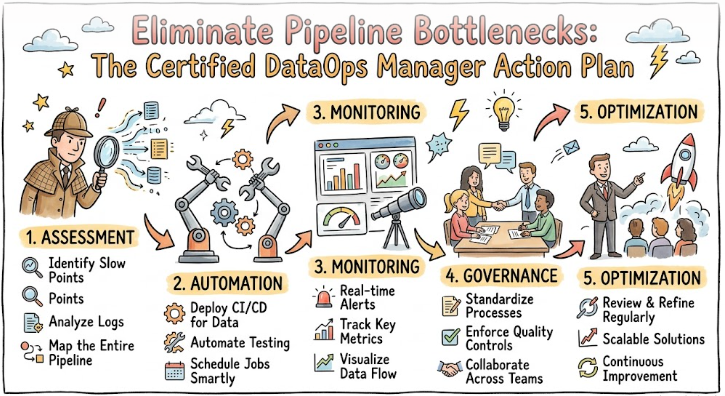
The CDOM – Certified DataOps Manager is a professional validation designed to establish proficiency in automating, monitoring, and governing continuous data delivery pipelines. Unlike traditional data management certifications that focus heavily on theoretical data modeling or specific database syntax, this program prioritizes real-world, production-focused engineering workflows. It addresses the critical need for reducing data lifecycle cycle times while maintaining high data quality and strict compliance standards. For modern enterprises, this certification represents a standard for professionals capable of breaking down silos between data scientists, engineers, and operations teams.
Who Should Pursue CDOM – Certified DataOps Manager?
This certification is built for multi-disciplinary professionals looking to validate their expertise in data orchestration and automated infrastructure. Systems engineers, Site Reliability Engineers (SREs), cloud architects, and data engineers will find direct relevance in the methodologies taught throughout this program. It is equally valuable for engineering managers and technical leaders who need to oversee complex data platforms and justify infrastructure investments. Globally, and specifically within fast-growing technology hubs like India, companies are actively seeking certified leaders who can minimize data downtime and streamline cross-functional delivery.
Why CDOM – Certified DataOps Manager is Valuable Beyond Traditional Roles
As enterprises adopt complex multi-cloud strategies, the volume and velocity of data require robust, automated operational frameworks. Holding this certification demonstrates that a professional can ensure long-term platform stability and high ROI, independent of underlying tool changes. It provides a strategic advantage by shifting the focus from manual troubleshooting to proactive, code-driven data architecture and governance. The investment of time and effort into this curriculum yields immediate career returns, positioning individuals for premium technical and leadership roles across major enterprises.
CDOM – Certified DataOps Manager Certification Overview
The structured educational program is delivered via the CDOM – Certified DataOps Manager and hosted on the main DataOpsSchool website. The certification process emphasizes practical execution, featuring rigorous assessment methods designed to test real troubleshooting and management capabilities. It covers various operational phases, shifting from foundational concepts to advanced architectural orchestration, ensuring a comprehensive validation of skills. Candidates are assessed on their ability to design resilient architectures, implement monitoring frameworks, and optimize total cost of ownership.
CDOM – Certified DataOps Manager Certification Tracks & Levels
The curriculum is structured into three progressive tiers to match different stages of professional development. The Foundation level introduces core automation concepts, version control for data, and fundamental pipeline monitoring tools. The Professional level elevates this knowledge by diving into complex orchestration, environment replication, and advanced quality assurance frameworks. Finally, the Advanced level is tailored for architects and technical managers focusing on global enterprise strategy, multi-cloud data compliance, and financial engineering for data platforms.
Complete CDOM – Certified DataOps Manager Certification Table
| Track | Level | Who it’s for | Prerequisites | Skills Covered | Recommended Order |
| Data Operations | Foundation | Associate Engineers & Systems Administrators | Basic Linux, SQL, and Git fundamentals | CI/CD for data, automated testing, versioning | First |
| Platform Engineering | Professional | Data Engineers, SREs & Cloud Architects | Foundation level or 2+ years data experience | Orchestration, data quality gates, monitoring | Second |
| Enterprise Leadership | Advanced | Engineering Managers & Enterprise Architects | Professional level or 5+ years leadership experience | Governance, multi-cloud scaling, cost optimization | Third |
Detailed Guide for Each CDOM – Certified DataOps Manager Certification
CDOM – Certified DataOps Manager – Foundation Level
What it is
This certification validates a foundational understanding of data operations, focus areas of continuous integration, and version control mechanisms for data pipelines.
Who should take it
Aspiring data engineers, cloud support professionals, and traditional database administrators looking to shift into automated data platform workflows.
Skills you’ll gain
- Version control implementation for schemas and data assets
- Basic continuous integration and continuous deployment pipeline design
- Automated data validation and quality check execution
- Fundamentals of monitoring and alerting for data pipelines
Real-world projects you should be able to do
- Build an automated Git-driven pipeline that validates schema changes before deployment
- Configure automated slack alerts for data pipeline execution failures
Preparation plan
- 7–14 Days: Focus on understanding the core manifesto of data operations and basic Git workflows for infrastructure.
- 30 Days: Implement small-scale automated pipelines using sample open-source tools and practice setting up foundational monitoring metrics.
- 60 Days: Review all practice scenarios, simulate automated failure recovery, and complete mock assessments to ensure time management skills.
Common mistakes
- Focusing purely on theoretical definitions instead of writing version control scripts
- Neglecting the fundamentals of standard software engineering practices applied to data
Best next certification after this
- Same-track option: CDOM – Certified DataOps Manager – Professional Level
- Cross-track option: Cloud Platform Associate Certification
- Leadership option: Technical Team Lead Foundation Course
CDOM – Certified DataOps Manager – Professional Level
What it is
This certification validates advanced technical capabilities in building resilient orchestrations, environment isolation, and comprehensive data observability frameworks.
Who should take it
Mid-level data engineers, Site Reliability Engineers, and cloud architects responsible for maintaining production data environments.
Skills you’ll gain
- Advanced workflow orchestration and dependency management
- Multi-environment management and automated data sandboxing
- Detailed data observability, tracing, and performance profiling
- Implementation of automated security and access control policies
Real-world projects you should be able to do
- Design a multi-stage orchestration pipeline that handles automatic failover and data backfilling
- Deploy an isolated staging environment that automatically masks sensitive production data
Preparation plan
- 7–14 Days: Deep dive into containerization, orchestration engine patterns, and advanced data lineage tracing methods.
- 30 Days: Set up complex, multi-stage pipelines with integrated automated testing and validation gates for schema drift.
- 60 Days: Focus on real-world troubleshooting scenarios, debugging performance bottlenecks, and practicing under timed exam conditions.
Common mistakes
- Underestimating the complexity of data lineage tracking across heterogeneous environments
- Ignoring the cost implications of running unoptimized automated validation workloads
Best next certification after this
- Same-track option: CDOM – Certified DataOps Manager – Advanced Level
- Cross-track option: Certified Site Reliability Specialist
- Leadership option: Certified Engineering Manager Practitioner
CDOM – Certified DataOps Manager – Advanced Level
What it is
This certification validates the strategic ability to design enterprise-wide data operations strategies, financial optimization frameworks, and global compliance systems.
Who should take it
Principal engineers, enterprise data architects, and engineering managers leading large-scale data organization units.
Skills you’ll gain
- Global data governance, lineage tracking, and compliance architecture
- Financial engineering, cost allocation, and resource optimization for data
- Enterprise-wide architecture design for multi-region scalability
- Strategic change management and technical leadership principles
Real-world projects you should be able to do
- Architect an enterprise data platform that automatically enforces global compliance regulations across multi-cloud environments
- Design an automated cost-attribution model that optimizes cloud spend across distributed business units
Preparation plan
- 7–14 Days: Review enterprise architecture patterns, data compliance laws, and financial tracking methodologies.
- 30 Days: Analyze case studies of large-scale transformations and design comprehensive governance strategies for complex organizations.
- 60 Days: Simulate executive presentations, refine risk mitigation strategies, and review advanced infrastructure optimization scenarios.
Common mistakes
- Focus over-indexing on technical coding details rather than holistic enterprise architecture and strategy
- Overlooking the cultural and organizational change management challenges inherent in data transformations
Choose Your Learning Path
DevOps Path
The DevOps path focuses on applying traditional continuous integration and delivery concepts directly to data management assets. Professionals learn to treat data pipelines as code, ensuring every change is thoroughly tested, tracked, and versioned. This path builds a strong foundation in automation tools, containerization, and infrastructure deployment strategies. It is ideal for systems engineers wanting to handle complex data delivery infrastructures efficiently.
DevSecOps Path
Security within data delivery is paramount, making this path essential for modern cloud environments. It integrates automated security scanning, data masking, and compliance validation directly into active data processing pipelines. Engineers learn to enforce access controls and vulnerability assessments without slowing down production release velocities. This ensures data privacy and regulatory compliance at every operational stage.
SRE Path
The Site Reliability Engineering path concentrates heavily on data platform availability, latency, efficiency, and capacity management. Professionals learn to define precise service level objectives for data delivery pipelines and create robust self-healing architectures. It emphasizes advanced monitoring, automated incident response, and proactive disaster recovery planning. This path guarantees that critical enterprise data services remain highly resilient and stable under heavy workloads.
AIOps Path
This path leverages artificial intelligence and machine learning technologies to optimize system performance and automate operational workflows. Engineers study automated anomaly detection within infrastructure logs, predictive maintenance patterns, and intelligent alerting mechanisms. It focuses on reducing operational noise, accelerating root cause analysis, and automating routine system maintenance tasks. This ensures platforms adapt intelligently to changing usage dynamics and performance demands.
MLOps Path
The MLOps path bridges the operational requirements between machine learning model lifecycles and continuous data pipeline execution. It provides professionals with techniques to manage feature stores, automate model training triggers, and track dataset versioning accurately. Engineers learn to deploy, monitor, and scale machine learning models in production environments safely. This guarantees consistent model performance and reliable data feed alignment over extended operational periods.
DataOps Path
Dedicated entirely to maximizing data flow utility, this path focuses on orchestrating data delivery workflows from ingestion to final consumption. It prioritizes the reduction of cycle time for analytical insights while strictly maintaining high data quality standards across pipelines. Professionals master data observability, schema drift management, and comprehensive testing strategies across complex, distributed data systems. This path creates specialists who turn raw data assets into reliable enterprise products.
FinOps Path
Managing infrastructure costs requires financial accountability embedded directly into cloud engineering and data architecture workflows. This path teaches professionals how to monitor resource consumption, attribute expenditures to specific pipelines, and optimize compute allocations. Engineers learn to build automated cost-alerting frameworks and design architectures that balance performance against budget limits. It ensures data operations scale efficiently without generating unexpected infrastructure expenses.
Role → Recommended CDOM – Certified DataOps Manager Certifications
| Role | Recommended Certifications |
| DevOps Engineer | CDOM Foundation + Professional Levels |
| SRE | CDOM Professional Level |
| Platform Engineer | CDOM Professional + Advanced Levels |
| Cloud Engineer | CDOM Foundation + Professional Levels |
| Security Engineer | CDOM Professional Level |
| Data Engineer | CDOM Foundation + Professional Levels |
| FinOps Practitioner | CDOM Advanced Level |
| Engineering Manager | CDOM Advanced Level |
Next Certifications to Take After CDOM – Certified DataOps Manager
Same Track Progression
After mastering the core fundamentals and strategic paths of this program, the most logical step is to dive deeper into specialized data platform management. Pursuing advanced validations in specific large-scale orchestration engines or complex real-time streaming architectures solidifies your standing as an expert. This continuous progression ensures you remain ahead of architectural shifts and master the nuances of high-throughput data pipelines.
Cross-Track Expansion
Broadening your technical horizon involves obtaining credentials in adjacent domains such as site reliability engineering or cloud security architecture. Expanding your skillset into generic platform engineering or automated infrastructure compliance helps build a versatile professional profile. This cross-domain expertise allows you to design comprehensive solutions that respect both data delivery needs and broader enterprise infrastructure mandates.
Leadership & Management Track
For those transitioning away from daily hands-on configuration toward organizational strategy, certifications in technology management and enterprise architecture are ideal. Pursuing credentials focused on digital transformation execution, financial cloud management, and engineering team leadership prepares you for executive decision-making. This transition enables you to effectively manage large engineering divisions and align technological investments with corporate business goals.
Training & Certification Support Providers for CDOM – Certified DataOps Manager
DevOpsSchool provides comprehensive instructor-led training programs designed to assist students through hands-on laboratory exercises and interactive technical bootcamps.
Cotocus delivers focused enterprise training solutions emphasizing live project implementations and customized engineering mentorship programs for corporate teams.
Scmgalaxy offers an extensive repository of community-driven resources, technical documentation, and practice guides to help professionals prepare for assessments.
BestDevOps specializes in accelerated training bootcamps focused on real-world production readiness and infrastructure automation techniques.
devsecopsschool focuses on integrating automated security methodologies, compliance checking, and vulnerability mitigation strategies into corporate technology pipelines.
sreschool provides targeted educational modules focusing on system resilience engineering, advanced performance monitoring, and reliable incident management procedures.
aiopsschool offers cutting-edge learning paths centered around the application of machine learning algorithms for automated system operations management.
dataopsschool serves as the primary hosting and delivery platform for specialized data operations educational certifications and skill evaluations.
finopsschool delivers specialized financial engineering training aimed at cloud infrastructure cost visibility, optimization, and budget accountability strategies.
Frequently Asked Questions (General)
- What is the primary benefit of getting certified in data operations management?
The main benefit is gaining a validated framework to automate data pipelines, improve quality control, and minimize cycle times in production environments. - How long does it typically take to prepare for these certification exams?
Depending on your existing background in cloud systems, preparation typically ranges from 30 days for foundations to 90 days for advanced levels. - Are there strict prerequisites required before attempting the professional exam level?
While prior experience with Linux and Git is highly recommended, candidates can enter the track based on practical experience or foundational certification. - What is the focus difference between data operations and traditional software DevOps?
DevOps focuses primarily on code deployment and infrastructure stability, while data operations manages the continuous, high-quality delivery of the data running through pipelines. - Can an engineering manager benefit from a highly technical data operations certification?
Yes, it provides technical leaders with the strategic understanding required to manage infrastructure costs, evaluate architectural designs, and organize cross-functional teams. - How often are the certification assessment materials updated to match current industry trends?The evaluation criteria and curriculum goals are reviewed systematically to align with emerging cloud native tooling and modern enterprise infrastructure patterns.
How often are the certification assessment materials updated to match current industry trends?The evaluation criteria and curriculum goals are reviewed systematically to align with emerging cloud native tooling and modern enterprise infrastructure patterns. - Does this certification pathway include hands-on practical lab scenarios?
Yes, the professional and advanced tracks place strong emphasis on validating practical troubleshooting capabilities through real-world scenario simulations. - What industries show the highest demand for certified data operations professionals?
Finance, healthcare, e-commerce, and cloud technology services show the highest demand due to their reliance on vast amounts of real-time production data. - How does this certification track help optimize cloud infrastructure spend?
By educating professionals on financial tracking, resource management, and pipeline efficiency, it prevents over-provisioning and reduces unnecessary compute costs. - Is knowledge of specific programming languages required to pass the assessments?
A basic familiarity with scripting languages like Python and structured query languages like SQL is helpful for the practical implementation sections. - What is the recommended approach for preparing for the practical lab portions?
Building personal infrastructure projects, configuring automated pipelines, and testing system failure scenarios are the most effective preparation methods. - Does this certification help professionals transition from traditional database administration?Absolutely, it offers a structured educational pathway to transition manual database administration skills into modern, automated cloud-native engineering capabilities.
FAQs on CDOM – Certified DataOps Manager
- What specific operational issues does the CDOM designation address for enterprise data platforms?
It directly addresses common operational challenges such as pipeline failures, schema drift, slow data processing cycles, and lack of cross-team coordination. By formalizing data management practices, it ensures organizations can deliver reliable data insights continuously without experiencing extensive downtime or operational friction. - How does the CDOM curriculum handle data compliance and governance requirements?
The program integrates data governance principles directly into automated workflows, rather than treating compliance as a manual afterthought. Candidates learn to implement automated data masking, traceability checks, and access controls within active processing pipelines, fulfilling legal mandates seamlessly. - Is the CDOM program centered around specific software tools or open-source platforms?
The certification maintains a framework-centric philosophy, teaching methodologies applicable across various environments, whether utilizing proprietary cloud suites or open-source stacks. This ensures that the strategic and operational skills acquired remain valuable regardless of tool migrations. - What makes the CDOM different from standard data engineering certificates?
Standard certificates focus primarily on writing queries or configuring data storage engines, whereas CDOM focuses on continuous integration, monitoring, and pipeline orchestration. It approaches data from an operations and reliability engineering perspective rather than purely an analytics viewpoint. - How does holding a CDOM certification impact long-term career advancement opportunities?
It positions professionals for senior leadership roles such as DataOps Director, Principal Data Architect, or Enterprise Infrastructure Manager by validating technical and management skills. It demonstrates an individual’s ability to align operational budgets with scalable, secure data architectures. - Can system administrators transition smoothly into data operations using this program?
Yes, system administrators can apply their knowledge of infrastructure, automation, and OS fundamentals directly to data management workflows. The foundational levels provide the necessary bridge to understand data pipelines, schemas, and lifecycle management effectively. - What mechanisms does CDOM teach to prevent production pipeline data corruption?
The curriculum teaches the implementation of automated data quality gates, environment isolation, testing structures, and real-time observability frameworks. These mechanisms catch anomalies early, preventing flawed or corrupted data from migrating further downstream to final analytical consumers. - How does the market view the credibility of the CDOM certification path?
The market recognizes it as a thorough validation of practical skills due to its focus on engineering scenarios and enterprise architecture. Organizations value the certification because it guarantees that a professional can manage complex data lifecycles efficiently and cost-effectively.
Final Thoughts: Is CDOM – Certified DataOps Manager Worth It?
Investing in the CDOM – Certified DataOps Manager path is a practical choice for professionals aiming to lead modern, automated data organizations. It moves beyond short-lived technology hype, offering a sustainable methodology grounded in established site reliability and continuous delivery concepts. For engineers and managers seeking to resolve operational inefficiencies, minimize infrastructure costs, and advance their technical careers, this certification path provides a structured, highly valuable roadmap to long-term success.

